
What Is 7050 Aluminum and What Are Its Primary Characteristics?

In the arena of high-performance metals, 7050 aluminum stands out as a material of exceptional versatility and strength. Whether for aerospace applications or other precision machining requirements, this alloy has become an indispensable feature in various industrial applications. Below, we look into the intricacies of 7050 aluminum alloy, identifying its primary characteristics and examining its various applications.

Composition of 7050 Aluminum

7050 aluminum belongs to the 7xxx series of aluminum alloys and is well-known for its advantageous strength-to-weight ratio. The composition of 7050 aluminum includes zinc as its main alloying element in addition to other elements of smaller percentages. The development of 7050 aluminum was instigated by the need for a high-strength material having excellent resistance to corrosion, making it a key component in various critical applications.

Notable as a vital alloy for aerospace applications, 7050 aluminum alloy stands out as a heat-treatable product. Known for its outstanding stress corrosion cracking resistance, high mechanical strength, and toughness even at temperatures below zero, this alloy is proven to be essential in the aerospace industry. It is specifically tailored for heavy plate applications, including bulkheads, fuselage frames, wing skins, and various structures that comprise aircraft.

Often available in two tempers, T7451 and T7651, 7050 aluminum alloy possesses and electrical conductivity at 40% of copper, reinforcing its adaptability or applications in which conductivity is a key factor. When working with Aluminum 7050, it is important to approach the welding of this metal with appropriate caution, as the welding process may potentially reduce the inherent strength of the alloy.

For an alloy to qualify as 7050 aluminum, it must possess a particular chemical composition as follows: Aluminum at 89%, Zinc at 6.2%, Copper at 2.3%, Magnesium at 2.3%, and Zirconium at 0.12%. These precise proportions ensure that Aluminum 7050 provides the exceptional combination of durability, resistance, and strength required for aerospace industry applications.

Alloy 7050: The Preferred Choice Over 7075 in Aerospace Applications

When it comes to aerospace applications, Alloy 7050 aluminum plates are often the preferred choice, particularly in the 3 to 6 inch thickness range, outdoing the usage of 7075. This preference is attributable to the excellent strength retention offered by 7050 in thicker sections. At Howard Precision Metals, we stock 7050 T7451 aluminum plate (AMS 4050), which provides superior resistance to stress corrosion cracking (SCC) and exceptional exfoliation corrosion resistance, although at somewhat lower levels compared to 7050 T7651 (AMS 4342).

Notably, 7050 T7451 exceeds alloy 7075 in terms of stress corrosion cracking resistance, corrosion resistance, and toughness. A lower sensitivity to quenching, a characteristic not common in many aerospace alloys, gives 7050 the ability to maintain its strength properties exceptionally well in thicker sections. This alloy also exhibits reliable machinability throughout the thickness of heavier gauges, making it distinct from other high-strength aluminum metal counterparts. At Howard Precision Metals, we are your premier and trusted source for 7050 T7451 aluminum plate, providing aerospace solutions that focus on machining consistency, resilience, and strength.

Primary Characteristics of 7050 Aluminum

1. High Strength: The notable characteristic of 7050 aluminum alloy is its exceptional strength. In its T7451 temper, this alloy possesses tensile strength values that exceed many other aluminum alloys. The enhanced strength of this alloy is a result of its unique composition, making it the desirable option for applications that require loadbearing capacity and structural integrity.

2. Superior Corrosion Resistance: In addition to its considerable strength, 7050 aluminum also possesses outstanding corrosion resistance. This characteristic makes it ideally suitable for applications that involve challenging environments, including atmospheric conditions to which aerospace components are commonly exposed. The resilience of this alloy against corrosion ensures its reliability and longevity in demanding operational settings.

3. Machinability and Formability: Despite its high strength, 7050 aluminum alloy maintains reliable machinability. This feature is vital for aerospace and automotive industry applications that require precision machining. The formability of this alloy enhances its versatility, enabling its manufacturers to produce intricate components with ease.

Applications Beyond Aerospace: Exploring the Versatility of 7050 Aluminum

1. Defense Industry: Beyond the aerospace industry, 7050 aluminum also finds application in the defense sector. The high strength properties of this alloy make it ideal for the manufacturing of armored structures, military vehicles, and related equipment, where reliability and durability are extremely important.

2. Sports Equipment: The recreation and sports industry also benefit from the special properties of 7050 aluminum. This alloy is used in the manufacture and fabrication of high-performance sporting equipment such as bicycle frames, where the combination of its lightweight and strength characteristics is required to enable optimal performance.

Choosing Howard Precision Metals for Your 7050 Aluminum Needs

At Howard Precision Metals, we are your premier source for premium 7050 aluminum products. We offer an extensive inventory of aluminum alloy products that includes 7050 T7451 aluminum plate, ensuring you have access to the materials you need for your projects. With a dedication to precision and quality, we work hard to serve as your trusted partner in utilizing the full potential of 7050 aluminum.

Strengthen Your Projects with 7050 Aluminum Alloy

If you are ready to benefit from the versatility and strength of 7050 aluminum for your next project, call our team today at 866.602.3788 or request a quote on our website.

What Benefits Does 6061-T651 Aluminum Offer in Architectural and Construction Projects?

In the world of architecture and construction, material selection plays a key role in determining the longevity and overall success of a project. One such versatile material extensively used in the industry is 6061-T651 aluminum. Well-known for its exceptional properties and wide array of applications, this aluminum alloy has become a preferred choice for construction professionals and architects alike. At Howard Precision Metals, Inc., we are your source for 6061-T651 aluminum alloy designed to meet a wide array of commercial and industrial applications.

Understanding 6061-T651 Aluminum: A Closer Look

Before looking into its applications, let’s examine the characteristics that make 6061-T651 aluminum a premier choice. This alloy is a heat-treated variant of 6061 aluminum, known for its excellent corrosion resistance, strength-to-weight ratio, and machinability. The ‘T651’ temper designation indicates that the material has undergone heat treatment and artificial aging, infused with enhanced durability and strength.

6061-T651 in Detail: Properties and Uses

To understand the significance of 6061-T651 aluminum in construction and architectural applications, it’s vital to grasp its properties. 6061-T651 features a high tensile strength, making it ideal for applications that require reliable structural integrity. Its corrosion resistant characteristic helps ensures its longevity, even in adverse conditions, such as those in industrial or coastal areas.

This adaptable alloy is applicable for structural and other engineering projects, marine vessels, staircase construction, furniture manufacturing, and other uses. The widespread adoption of 6061 aluminum alloys can be attributed to its exceptional strength-to-weight ratio, superior corrosion resistance, and remarkable toughness.

The popularity of our 6061 aluminum plate products, commonly called 6061-T651, is seen in its use for varied purposes, such as the fabrication of structural components, base plates, ramps, aluminum flooring, and stairs. In addition to its durability, 6061 aluminum offers superb machinability, making it ideal for an array of machining applications, and it is also highly suitable for welding applications.

Architectural Marvels with 6061-T651 Aluminum

Architects turn to 6061-T651 aluminum for its unique combination of malleability and strength, allowing them to design durable and visually stunning structures. From complex interior elements to sleek façades, this aluminum alloy provides exceptional design flexibility. Its lightweight characteristic minimizes the load imposed on another structural elements, adding to ease of construction and cost efficiency.

Strength in Design: A key benefit of 6061-T651 aluminum as it relates to architecture is its ability to contribute toward innovative designs. The strength of this alloy enables architects to utilize more complex shapes and design configurations, pushing the envelope of standard or traditional design boundaries.

Durability Beyond Aesthetics: Architectural designs require materials that are not only visually appealing, but will also hold up under the elements over time. The corrosion resistance of 6061-T651 aluminum ensures that buildings reserve their aesthetic appeal for years, keeping the architect’s vision intact and minimizing maintenance costs.

6061-T651 in Construction

In the construction industry, material reliability is exceptionally important. 6061-T651 aluminum, with its durable properties, is commonly used in various construction applications, providing uncompromising strength for dependable performance.

Structural Components: Construction projects often require materials that are able to support heavy loads without losing their structural integrity. 6061 aluminum plate is used extensively to support structural loading conditions. The high strength of 6061-T651, whether in the form of columns, beams, trusses, or panels, helps ensure the stability of various structures.

Machinability and Fabrication Ease: Timelines in the field of construction are crucial, and the ease with which 6061-T651 aluminum can be machined and fabricated adds to project efficiency. The machinability of this alloy allows for rescission cuts and configurations, reducing the effort and time required in the assembly and construction process.

A Material of Choice

For both construction and architectural applications, 6061-T651 aluminum is often one of the main materials of choice, providing the perfect combination of design flexibility, strength, and durability. Whether the need involves the construction of an industrial facility or the sleek silhouette of a modern skyscraper, this alloy plays a significant part in modern day construction projects.

Your Source for 6061-T651 Aluminum

With the unique demands of construction and architectural projects in mind, we acknowledge that our assorted array of clients requires customized solutions for their 6061 T6 aluminum sheet and related requirements. Our extensive experience that spans decades enables us to deliver aluminum products that are ideally suited for the various complexities of architectural and construction applications.

Our dedication to excellence is proven through the significant investments we have made in our custom-built, high-speed aluminum plate saws and a variety of other specialized tools that are essential for achieving consistent, superior results. With our focus exclusively on aluminum, we have fashioned our business operations to fulfill the distinct needs of customers in the architectural and construction industries.

Emphasizing customization and the thorough maintenance of our cutting-edge saws, we reinforce our dedication to excellence through our extensive qualification processes that only involve premier quality mill sources. As a dedicated 100% aluminum distributor equipped with custom equipment, we have the tools and expertise necessary to meet the needs of the most challenging architectural and construction project applications. Whether faced with a complex design specification or requiring advice for your next 6061 aluminum plate project, we are your trusted source for helping you fulfill your architectural or construction vision.

Get 6061-T651 Aluminum for Your Project

Are you ready to ensure the success of your architectural or construction project with the outstanding qualities afforded by 6061-T651 aluminum? Call us today at 866.602.3788 or request a quote through our website to get the process started.

How Does MIC 6 Aluminum Contribute to the Aerospace and Aviation Industry?

In the complex arenas of aviation and aerospace, reliability and precision are absolutely essential. MIC 6 aluminum, well-known for its unique characteristics, has come to the fore as a key player in these industries, providing superior benefits for diverse applications. At Howard Precision Metals, we offer MIC 6 cast aluminum in various sizes and thickness to meet the needs of your current or next project.

Below, we examine the distinguishing qualities of MIC 6 aluminum and cover why it provides such a significant contribution to the aerospace and aviation sectors.

Understanding MIC 6 Aluminum: Characteristics and Applications

The MIC 6 Advantage: MIC 6, a cast aluminum alloy with a strong reputation for its stability and flatness, also offers the benefits of precision and reliability. This alloy’s micro-structure and low internal stresses make it an effective material choice for applications in which consistency and tight tolerances are of exceptional importance.

The uniqueness of aluminum MIC 6 stems from the specialized alloy composition it possesses and the method by which it is cast and carefully produced to yield high-tolerance, stable plates. Well-known for its considerable stress-relieving properties, Aluminum MIC 6 offers the additional benefits of exceptional machinability and extraordinary accuracy. Moreover, this alloy offers the unique characteristic of being porosity free and contaminant free, giving it greater appeal for applications in which precision and purity are vital.

Wide Range of Applications: From industrial tooling to precision machining, MIC 6 aluminum finds applications across multiple industrial sectors. The stability and versatility of this aluminum alloy make it a material of choice for applications that require exceptional flatness, including fixtures, jigs, and mold plates.

MIC 6 in Aerospace: A Foundation for Optimum Performance

Structural Components: In the aerospace industry, where precision, strength, and weight are critical factors, MIC 6 aluminum plate plays an essential role in the construction of structural components. These plates, known for their superior stability and flatness contribute to the fabrication of fuselage components, wing structures, and other critical parts where precision is crucial for achieving optimal aerodynamics.

Tooling and Fixtures: The stability of MIC 6 cast aluminum makes it a vital material for the production of fixtures and tooling used in aerospace manufacturing. The material’s warping resistance and resistance to dimensional changes when subjected to varying temperatures ensures the accuracy of machining processes, contributing to the production of complex and high-tolerance components.

Enhanced Thermal Efficiency: In the aviation and aerospace industries, MIC 6 aluminum has been proven essential due to its thermal conductivity, a key factor in applications that necessitate efficient heat dissipation. This characteristic makes MIC 6 aluminum an ideal choice for jig plates and tooling within the aerospace sector, where sustaining precise temperature stability is of great importance.

Advanced Protection and Customization for Components: MIC 6 aluminum features an intrinsic anodizing response, providing improved surface protection and customization potential, which meets the needs of various aerospace applications. Its reliable dimensional stability when exposed to varying environmental conditions ensures its consistent performance, making it a dependable material for vital aerospace components and systems. In addition, the seamless weldability of MIC 6 aluminum adds to its versatility, giving aerospace engineers and manufacturers greater latitude in the design and production of aircraft components.

MIC 6 in Aviation: Enhancing Performance and Precision

Engine Components: MIC 6 aluminum is utilized in the fabrication of engine components for aviation applications in which engines operate under extreme conditions. The alloy’s resistance to contraction and expansion along with its stability make it an ideal choice for parts that require reliability and dimensional precision, bolstering the overall safety and efficiency of aircraft engines.

Prototyping and CNC Machining: The machinability of MIC 6 aluminum makes it a preferred material for CNC machining and prototyping applications in the aviation industry. The material features consistent properties that make it ideal for producing intricate designs and performing precise machining, all of which ensures that the end product and prototypes adhere to strict industry standards.

MIC 6: Your Aluminum Alloy When Precision is Paramount

While MIC 6 offers exceptional machinability flatness, and stability, it’s also important to consider factors such availability and cost when considering its use. Despite these considerations, the benefits of MIC 6 often outweigh any potential downsides, particularly in industries and applications in which precision results are of premier importance.

Choose Howard Precision Metals for Your MIC 6 Needs

With a rich history of over 90 years, Howard Precision Metals has developed into a full-fledged, state-of-the-art aluminum service center, operating at the forefront of the industry. With a reputation for supplying precision products, we have garnered recognition from top industry producers.

With a specialization in fulfilling various aluminum alloy product requirements, our team is highly capable of handling complex cutting tolerances, including those which involves MIC-6 aluminum cast tool & jig plate. Our highly skilled team is ready to assist you in securing the aluminum alloy products which are customized and ideal for your specific application.

We understand the critical role MIC 6 plays in the aviation and aerospace industries. Our dedication to delivering top-tier materials, including MIC 6 aluminum plate, ensures your applications benefit from the unique and exceptional characteristics of this alloy.

Reach New Heights with MIC 6 Aluminum

Are you ready to enhance your aerospace and aviation projects with the stability and precision of MIC 6 cast aluminum? Give us a call today at 866.602.3788 or request a quote on our website to learn more.

Knowing Your Aluminum Alloys and Applications

When it comes to manufacturing aluminum, choosing the right alloy is crucial for achieving optimal results. Different aluminum alloys have different properties that affect machinability, workability, weldability, hardness, strength, and thermal conductivity. As we all know some alloys will perform better than others in each of these situations.  In this post, we’ll take a closer look at the best aluminum alloys for machining, welding, forming and stamping.

6061 Aluminum Alloy

6061 is a popular aluminum alloy that is known for its excellent machinability and weldability. It has good corrosion resistance and is widely used for structural applications. 6061 aluminum can be easily machined using standard techniques and is suitable for both manual and CNC machining. It is a heat-treated alloy that has average strength providing good machinability but still allowing it to be easily formed and stamped into a component.  When we look at all the alloys we will talk about today, 6061 is the most versatile of the alloys for multiple applications.  That is why it is the most common Aluminum alloy specified.  

7075 Aluminum Alloy

7075 is a high-strength aluminum alloy that is commonly used in aerospace and automotive applications. It has excellent machinability but is more difficult to work with than 6061 due to its high strength. It also has good corrosion resistance and is heat treatable, allowing for further improvements in its mechanical properties. 7075 is suitable for CNC machining and is often used in the production of aircraft parts and high-stress components.  Because 7075 contains copper and zinc, it is not suitable for welded structural application as the welding process creates microcracks that impact the tensile strength of the weld zone.  This is one of the reasons some airplane components are riveted.  

2024 Aluminum Alloy

2024 is another popular aluminum alloy that is widely used in aerospace applications. It has good machinability and can be easily worked with using standard techniques. 2024 is also heat treatable, so depending on the temper designation, your strength is on the high compared to other Aluminum alloys.  However, it is not as strong as 7075 and is not suitable for high-stress applications. 2024 is often used in the production of aircraft skins, structural components and higher-pressure manifold applications.  

6063 Aluminum Alloy

6063 is a popular aluminum alloy that is used for extrusion and architectural applications. It has good corrosion resistance and is machinable using standard techniques. It is not considered a good machining alloy, but as long as you are not doing deep drilling you will be fine.  6063 also has good thermal conductivity and is suitable for heat transfer applications. 6063 is a highly extrudable alloy, lending itself to complex shapes like heat sinks with thin fins, window frames, door frames, and other architectural components.  The strength of 6063 is significantly lower than the above alloys, and typically not specified in structural applications.

5052 Aluminum Alloy

5052 is a popular aluminum alloy that is commonly used in marine and automotive applications. It has good workability and weldability and is highly resistant to corrosion in seawater. 5052 is also easily formable, making it a great choice for applications that require complex shapes. Because 5052 is not heat treated, successfully rolling forming bending and stamping are often processes done to 5052 sheet and plate.  End uses for 5052 include fuel tanks, signs, cabinets and other general sheet metal parts

5083 Aluminum Alloy

5083 is a high-strength aluminum alloy that is commonly used in marine applications. It has good machinability and weldability and is highly resistant to corrosion in seawater. 5083 is also heat treatable, allowing for further improvements in its mechanical properties. It is often used in the production of boat hulls, decks, and other marine components.

Understanding the properties of different aluminum alloys is important for choosing the right one for your machining needs which we will now focus on. Factors to consider include the alloy’s strength, machinability, corrosion resistance, and thermal conductivity. When selecting an aluminum alloy for machining, it is important to balance these factors to achieve the desired results.

In addition to the previously mentioned alloys, there are several other aluminum alloys that are commonly used in machining applications, such as 2011, 2017, 5052, and 6060. Let’s take a closer look at these alloys and what makes them suitable for machining.

2011 Aluminum Alloy

2011 is a free-machining aluminum alloy that is ideal for high-speed machining operations. It is all about the excellent machinability this alloy offers in the screw machine process and other bar-fed CNC machines. 2011 has comparable strength to 6061, but other than that, it is limited.  This alloy is only produced as Cold Finished bar, giving it tight dimensional tolerancing.  2011 is often used in the production of screws, bolts, and other small components. 

2017 Aluminum Alloy

2017 is a high-strength aluminum alloy that is commonly used in aerospace and military applications. It has good machinability and is often used in the production of aircraft parts and other high-stress components. 2017 is also heat treatable, allowing for further improvements in its mechanical properties. It has good corrosion resistance and is suitable for use in harsh environments.

When selecting an aluminum alloy for machining, it’s important to consider not only the alloy’s properties but also the specific machining process that will be used. Different machining processes, such as turning, milling, or drilling, require different properties from the alloy. For example, milling requires an alloy with good thermal conductivity to dissipate heat, while drilling requires an alloy with good machinability to reduce tool wear.

It’s also important to consider the surface finish requirements of the final product. Some alloys may be more prone to surface defects, such as burrs or chatter marks, than others. Choosing an alloy that is well-suited to the specific machining process and surface finish requirements can help ensure a high-quality final product.

In addition to the properties of the alloy itself, the machining process itself can also affect the machinability of the alloy. Factors such as cutting speed, feed rate, and tool geometry can all affect the performance of the alloy during machining. It’s important to optimize these parameters for each specific alloy and machining process to achieve the best results.

In conclusion, selecting the right aluminum alloy for your manufacturing process depends on a variety of factors, including the specific application, the manufacturing process, and the desired aesthetics of your finished part. While 6061, 7075, and 2024, and are all popular choices for machining, other alloys such as 2011, 2017, 6063, 5052, and 5083 are also well-suited for certain applications. By understanding the properties of these alloys and optimizing the type of manufacturing performed, you can achieve optimal results and produce high-quality parts.

Five Tips to achieve a successful Aluminum Extrusion Design

As a distributor, it is important that our customers have a clear understanding of the product they are receiving and the associated industry tolerances that go with it.   Ensuring that our customers receive high-quality products is essential for maintaining a positive relationship as well as quality reputation, resulting happy customers. One critical aspect of this is ensuring that the products we provide meet the required specifications, including dimensioning and tolerancing.

To ensure that our customers receive products that meet their exact specifications, here are five tips to consider when it comes to dimensioning and tolerancing:

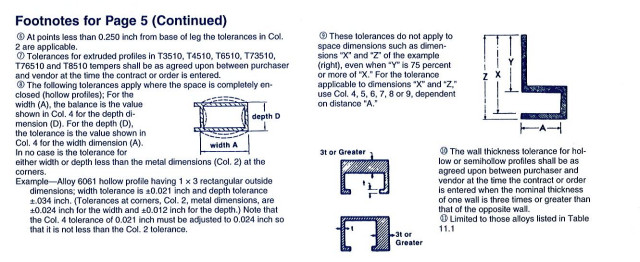
1. Understand the design requirements: Before providing any product to our customer, we make sure together with our customer we have a thorough understanding of their design requirements. The engineering responsibility is that of the customers, but often they do not understand the idiosyncrasies of the extruding process and need a little guidance to the potential pit falls.  This starts with a clear understanding of their desired tolerances and any other specifications that may affect the dimensions of the product.  The more complicated the extrusion design is, the more complicated the tolerance are to understand.  Below is the industry standard tolerances that extrusion mills typically follow.  They are referred to as AA tolerances.  The chart below does not mean that a mill can’t produce tighter, but it should be assumed that if not indicated on the drawing they are quoting standard AA tolerances.  It is the job of the designer to ask for better if needed.

Aluminum Extrusion Companies

2. Utilize CAD software: Providing the desired shape in a CAD software file like .DWG or .DXF can help ensure that your dimensional measurements are accurate and allow for ease in quoting your finished shape.  Minor recommended changes by the extruder for ease of extruding, can easily be made to an existing drawing with the comparison changes to be discussed as options.  Having a accepted design in a CAD file is especially important for extrusions, which have intricate geometries that can be difficult to measure accurately by hand on the extruded shape.

Double-check measurements: Once you have laid out the measurements, double-check them to make sure they are correct. This will ensure that your products meet the design requirements and specifications you want.

Verify materials: Be sure to understand the differences in extrusion alloys.  Some provide high strength and better machinability but are more difficult to make complex shapes in an extrusion.  Other alloys flow better through complex die designs but are not as high of strength.  It is important to verify that the alloy in your design meets the strength, corrosion, anodizing, and surface requirements of your end part.  Make sure that the material meets these requirements, as well as any industry standards or regulations.

3. Pay attention to surface finish: Often the extruded surface is the finished surface of a part, meaning there is no machining being done to that surface.  Producing mills are very sensitive to what they call “exposed surfaces”, meaning not only is the surface not machined, but it is an exposed surface visible on the finished product to the consumer, and must look nice.  If the extruder understands which surfaces are exposed, the die can be designed to minimize potential surface imperfections when the extrusion is running out of the extrusion press.  The surface finish of a product can also have impact on its dimensions and tolerances. Make sure you understand how important the surface finish is to your finished product.  It will save a lot of headaches in the long run.

4. Consider post extruding manufacturing processes: Understanding the manufacturing processes used to create the finished product is important for accurately assessing its dimensions, tolerances, and finished surface condition required. For Example.  Many cutoff saws have pneumatic hold down clamps that can put too much pressure on a thin wall of an Aluminum extrusion and potentially crush the metal changing the shape of the part.  The same thing can happen in a fixture of a machining center.  Make sure you have a thorough understanding of the manufacturing process that will take place on your custom extruded shape and any associated tolerances you need to hold.

5. Communicate clearly with your suppliers: Finally, clear communication with your suppliers is essential for ensuring that the products they provide meet your required specifications. Make sure you provide detailed specifications to your suppliers and have open lines of communication to address any potential issues that may arise.

By following these tips, you can ensure that the custom extruded shapes you purchase will meet your specifications.  You will also find that you will look to Aluminum extrusions in the future as a cost-effective design option for saving money by reducing weight, secondary operations, and time. This process requires a custom extrusion partner that will take the time to clarify all these points. Howard Precision Metals is a dedicated Aluminum distributor focused on providing the knowledge and expertise in Aluminum plate, bar, and custom extruded shapes. Contact Howard Precision Metals on your next custom extrusion requirement.

Properties of Manifold Quality Extruded Bar

At Howard Precision Metals, we offer an extensive inventory of 6061 extruded aluminum bar in an array of sizes that meet the needs of various applications. This includes a significant number of our rectangular and square extrusions in manifold quality extruded bar.

Manifold Quality Bar Sizes

The entire range of manifold quality aluminum extruded products we carry are extruded to the plus side at ½ the Aluminum Association published thickness and width tolerances, as opposed to a plus/minus AA standards. This provides the user with extra stock for machining purposes. The range of sizes offered for the bars are 1” x 1.25” through 6.0 x 8.0 in rectangles and 0.875” x 0.875 through 6” x 6” in squares. Outside of these size ranges, custom extruded aluminum in squares and rectangles are usually made to AA standards with +/- tolerances.

Manifold Quality Bar Tolerances

When the custom extruded aluminum size changes, the tolerance also changes. The tolerance of a 2” x 2” manifold quality extruded bar, for example, will have a +.012”/-0” tolerance vs. a +/-.012” tolerance from the Aluminum Association. By making plus-side only tolerances available with these bars, in many cases there is less need to order the next available bar size. The benefits include reduced weight of bar purchases, less machine time, and lower cost of materials.

Improved Tolerances, Strength, and Machinability

Beyond the plus-side only and stockier custom extruded aluminum bar dimensions, manifold quality 6061 aluminum extrusions also provide enhanced flatness tolerances, dimensional control, straightness, twist, in addition to better machinability, and greater mechanical strength. As a result of the compact chips produced from drilling and boring operations, the machining throughput of a manifold quality extruded bar is improved. This allows for a consistent mechanical process.

These bars are ideal for customers who produce various types of machinery and equipment, telecommunications electronics, pneumatic and hydraulic manifolds, and fixtures.

Highly Machinable

The mills we work with on a consistent basis have committed their resources to upgrading their aluminum extrusions by enhancing performance on piece-to-piece and lot-to-lot basis, manufacturing products that result in the formation of smaller-sized chips under machining operations and promising bars that produce less burring. The improvements made by these mills allow manifold quality extruded bar to endure more complex machining processes with the removal of large voids.

Manifold Bar Alloy and Temper

Aluminum is not that strong as a stand-alone element. However, when it is alloyed with certain elements its strength can increase significantly, with certain alloys comparing with the strength of steel. The alloy and temper designation of manifold bar is 6061-T6511. When magnesium, silicone, and other elements are added to aluminum, 6061 alloy results.

The -T6511 temper adds artificial aging and heat treatment for increased strength and stretching to relieve stress. Some of the major benefits of 6061 alloy are its machinability, strength-to-weight ratio, and great surface finish, making it ideal for many applications, including in the form of extruded aluminum bar.

Due to the inherent characteristics and tolerances of 6061-T6511, it is the ideal option for the production of manifold quality extruded bar. However, 6061-T6511 does not have the standard chemistry for manifold quality bar. Therefore, in order to achieve greater strength and better machinability, the recipe has been refined. This results in a yield and tensile strength of 38,000 KSI and 42,000 KSI respectively for manifold quality bar as opposed to 35,000 KSI and 38,000 KSI respectively for standard 6061-T6511.

Optimize Profits With Custom Manifold Quality

It is possible to get a custom manifold quality extruded bar made to the exact size you need for your applications. Offering ½ Aluminum Association tolerances all on the plus side, we are able to help you increase your profits by reducing the pounds you purchase and minimizing your cycle time per part. The costs for aluminum tooling are small compared to other tooling expenses.

Typically it costs between $700 to $1000 to manufacture a new, custom solid square, rectangle, or round custom aluminum extrusion bar. Through amortization of the cost compared to the savings achieved, it will only take a few runs to pay for the die. Custom aluminum extrusion dies are ideal for repetitive requirements since 1000 pounds is the starting press minimum. As a result of these facts, you can achieve greater profitability with custom extruded aluminum and keep your operations in house. It is wise to evaluate the various advantages afforded by custom aluminum extrusions before a competitor does.

Also, don’t automatically assume the aluminum bar you purchase elsewhere meets manifold machinability and tolerances. The extrusion process and required oversight at the mill to meet the standards of manifold quality extruded bar are special. It needs to include the properly controlled chemistry that provides the required enhanced consistency and machinability.

For the custom extruded aluminum and manifold quality extruded bar you need, call us today at 800.444.0311 or request for quote using our online form.

What Is Marine Grade Aluminum?

Because water and saltwater have a corrosive nature, special materials are required to resist these corrosive forces in the process of building assets exposed to these elements – this includes off-shore drilling platforms, shipbuilding, and more. Marine grade aluminum provides several beneficial characteristics that are ideally suitable for the construction of vessels and equipment at sea. At Howard Precision Metals, we offer an extensive array of Aluminum alloys, but don’t get much call for marine grade aluminum here in the Midwest. This blog is more about education as we consider ourselves the Aluminum experts even in alloys we may not stock.

Choosing the Right Aluminum for Near-Water Applications

Even though it may not be the best material for constant or permanent submersion, aluminum is a popular metal choice when it comes to the building of docks, ladders, pontoons, boats, and boat trailers due to its strength and lightweight characteristics. Aluminum develops an aluminum oxide coating when it is exposed to water and air that helps protect the metal against additional corrosion.

The aluminum grade chosen for marine environments is important. The 3000 series aluminum alloys are susceptible to fast oxidation. If you need an aluminum alloy that will be exposed to water or the moisture coming off the water, it is important to use a marine grade aluminum alloy, such as those in the 5000 or 6000 series. When proper maintenance and care are applied these aluminum grades can ensure a long service life for items constructed for marine purposes.

Marine Grade Aluminum Features

Although aluminum by itself, compared to many other metals, offers high corrosion resistance, it requires additional protection when exposed to water and moisture in marine applications. The alloying process combines aluminum with other metals such as magnesium to create an even stronger resistance to corrosion, making it more ideal for applications that contact water and saltwater. These types of aluminum alloys are referred to as marine grade aluminum.

Cast and Wrought Marine Grade Aluminum Alloys

Aluminum alloys are usually categorized based on the primary alloying element added to the aluminum along with the capability of the alloy to react to mechanical and thermal treatments.

Cast aluminum alloys are produced through a process which involves pouring molten metal liquid into molds of specific shapes and then cooled.

Wrought aluminum alloys are made through a process of rolling, forging, or mechanically deforming solid metals to the desired shape.

Marine grade wrought aluminum alloys often include aluminum magnesium silicone alloys and aluminum magnesium alloys. These wrought alloys of aluminum are often used for docks, boat lifts, structural shipbuilding, and other offshore structural applications.

Cast aluminum alloys are suitable for many different types of marine applications since the casting process allows for the creation of various intricate shapes, such as those for structural components, supports, interior fixtures, and a ship’s superstructure. These alloys are often aluminum silicone alloys or aluminum magnesium alloys.

5052 Alloy: High Fatigue Strength Benefits

Marine grade aluminum 5052 is a non-heat treatable aluminum alloy that possesses exceptional fatigue strength beyond most other aluminum alloys. It also provides good workability for easy forming into intricate shapes and provides solid corrosion resistance to marine saltwater and atmospheric conditions.

6061 Alloy: Workability and Corrosion Resistance

Aluminum 6061 is a highly versatile alloy for use in marine grade applications. It has excellent corrosion resistance and other mechanical properties. Under the annealed condition, it possesses solid workability and different techniques are used when fabricating this aluminum alloy. Marine grade aluminum 6061 is offered in sheet, plate, and extruded shape forms and is ideal for an array of near-water applications.

As an aluminum alloy with added silicon, grade 6061 offers superb corrosion resistance and is also easier to finish and weld than aluminum grade 5052. This alloy of aluminum is often used when extra strength is required. It is often used when workability and other properties will be helpful considering its higher cost.

6063 Alloy: Decorative and Structural Purposes

Aluminum alloy 6063 is used primarily for architectural and decorative purposes as opposed to structural support purposes. It has excellent corrosion resistance, tensile properties, and finishing characteristics. This aluminum alloy is used for various exterior and interior architectural purposes, including for trim.

Applications for Marine Grade Aluminum

Marine grade aluminum alloy is not only used for railings, docks, stairs, ladders, and other items and furnishing on or close to the water, it can also be used for storage facilities and tanks that are not specifically marine-related.

Another applicable aluminum product for marine use is aluminum honeycomb panels. These panels provide a number or advantages properties, including:

  • High strength and light weight
  • High impact resistance
  • High rigidity
  • Vibration dampening
  • May be fabricated to various thicknesses
  • Good insulation from sound and heat

Benefits of Marine Grade Aluminum

The various properties of marine grade aluminum alloy that make it ideal for marine conditions include:

  • Excellent resistance to corrosion due to saltwater exposure
  • Very lightweight with an excellent strength-to-weight ratio
  • Offered in multiple grades, plates, sheets, and extrusions
  • Usable with various fabrication procedures

For information about the marine grade aluminum alloy products we offer at Howard Precision Metals, give us a call at 800.444.0311 or request a quote today.

Sand Casting vs. Die Casting vs. Investment Casting

The process of casting manufacturing involves the pouring of a molten metal into the cavity of a mold designed to produce a specific shape, which is then allowed to cool and harden. After the molten material solidifies, the newly-formed workpiece is extracted from the mold and subjected to finishing processes that results in the final product. Metal casting, including aluminum casting, is often used to create complex hollow and solid shapes. Casting is used for various industrial applications, including those in the aerospace and automotive industries.

Below we cover three popular casting processes – Sand Casting, Die Casting, and Investment Casting. The choice of casting must be made based on various considerations related to engineering, design, manufacturing, and cost.

Sand Casting

Sand casting usually depends on materials that are silica-based. These can include naturally-bonded or synthetic sand. The sand used for casting is typically spherical, finely ground grains that are packed together tightly into a smooth molding surface. This form of casting tends to reduce the possibility of cracking, tearing, and other defects by introducing shrinkage and flexibility into the cooling process. Clay may be added to strengthen the sand, helping to strengthen the bond between particles. Sand casting is often used to produce engine blocks.

The level of accuracy produced with sand casting is generally lower than with other methods. The products yielded from this process, including aluminum casting with the sand casting method, also tend to have a comparatively rougher surface finish.

Die Casting

The die casting process molds materials under high pressure and is often used for non-ferrous metals and alloys such as aluminum, copper, zinc, and tin. A lubricant is coated onto the surface of the mold to keep the temperature of the die under control and make material extraction from the mold easier. With this casting method, molten metal is placed into the die under high pressure, which is maintained until the solidification of the workpiece occurs.

The benefits of die casting, including when performed for aluminum casting needs, such as uniform design, high components dimensional consistency, closer near net shape and size tolerances, and less of a need for machining after the casting phase.

Die casting does have high tool costs, which means high volume production runs will increase its cost-efficiency. Also, products made with die casting are not often structural in nature since it is challenging to ensure the mechanical properties of a die-cast product.

Investment Casting

Investment casting utilizes a disposable wax pattern for each part cast. The wax is placed into a mold. It is then removed and covered with refractory material and a binding agent. This is often done in multiple stages to create a thicker and thicker shell. Various patterns are put together onto common sprues. After the shells have hardened, the patterns are inverted and then placed into ovens for heating to remove the wax. Then, the molten metal is emptied into the remaining shells. The resulting piece which has hardened reflects the wax pattern shape. The refractory shell is then removed to display the hardened casting. This method of casting is often utilized in the power generation, automotive, and aerospace industries, including for turbine blades.

Investment casting benefits include:

  • Exceptionally precise and accurate dimensional results.
  • Ability to cast ferrous and non-ferrous metals
  • Produces exceptional quality surface finish and component details
  • Can produce parts with complex geometries and thin walls

The quality surface finish produced through investment casting (for metal and aluminum casting) can compensate at times for the higher expense associated with this casting method.

Sand Casting vs. Die Casting

The mold types used for each method are different. Sand casting uses sand mold, while die casting uses metal molds. Dies casting is more ideal for parts that require dimensional accuracy and is ideal for higher production runs.

Sand Casting vs. Investment Casting

Sand casting produces a rougher surface finish and can produce net shapes within 1/4 of an inch. Investment casting produces excellent surface finishing and is the optimal choice for highly complex designs. Sand casting offers greater versatility with weight and size capabilities than investment casting.

Die Casting vs. Investment Casting

The differences between die casting and investment casting include:

  • Die casting uses reusable molds while investment casting uses disposable molds for each new cast.
  • Die cast parts may require some post-processing in order to achieve desired finishes and dimensions, while investment casting generally requires little to no additional processing.
  • Investment casting is ideal for production runs in the low to medium volume range, while die casting is more suitable for production runs in the high volume range.
  • Die casting may only be used for non-ferrous metal casting, while investment casting can be used on both ferrous and non-ferrous metals.

When it comes to aluminum casting and other metal casting, the casting methods mentioned above have their own unique benefits and drawbacks that make them ideal for certain manufacturing requirements.

The significant benefit to using any casting method is you end up with a part that is close in size and weight to the end product of your part. Yes, it will involve finish machining but it saves you a both machining time and metal over machining your part from a solid piece of Aluminum, whether from a wrought or cast aluminum plate.

At Howard Precision Metals we often get asked what is more cost effective, machining a part from a solid block or from a casting? As mentioned above the tooling for a cast part needs to be amortized over the run quantities. If your quantities are low, it normally does not justify tooling up a mold for casting. However, if you have high run quantities that will keep increasing over the lifetime of a part, a casting should always be considered. Should you need Aluminum cast or wrought blocks to machine your prototypes from prior to casting Howard Precision Metals is here to help.

To learn about the standard and custom aluminum products we offer, including custom aluminum extrusions, give us a call today at 800.444.0311 or request a quote.

How to ensure your metal supplier meets your needs

In today’s manufacturing environment, we all have a lot on our plate. Therefore, it is even more important to choose the right metal supplier. You need that supplier to meet your needs from a quality, delivery, and competitive perspective.

There are many quality metal distributors to choose from, but understanding the difference comes down to a respect for each other and good communication. In order to be the best supplier, there needs to be a two-way street, and if you expect clear and timely communication from your metal supplier, you must first start by giving them all the information they need.

Include metal specifications on your RFQ

All metals are produced to certain specifications that typically define their chemistry, physical properties requirements, method of production, and even country of origin of the mill producer. Today, a test report, or mill certification will often state the country the alloying elements are mined from as well. Some governments limit producers from supporting countries that conflict with their beliefs. It is always good to include every specification you have, as well as any alternative specifications that can also be used. Giving your supplier all the possible options will allow them to quote you the most competitive price.

Tell them when you need the metal.

As we all struggle with availability of some metals due to both a limited global supply chain and shortage of manufacturing workers, it is important that you are clear from the beginning with your delivery needs. A quality metal supplier will always be honest with you if they are unable to meet your delivery. Sometimes, if the requirement is so large, they may have to split the shipments or tell you they can only supply a given amount of your needs. At Howard Precision Metals, a distributor of Aluminum Plate, bar and extruded products, we pride ourselves on being transparent. We would rather lose an order than lose a customer’s trust by promising a delivery we can’t meet. In addition, there are many logistic challenges facing your metals suppliers today, due to the CDL driver shortages. If material does not arrive to your supplier on time, causing your order to not ship as promised to you, a good supplier will advise you before you even realize it is late.

Specify your required tolerances.

Not all producers of metal are created equal. We are dependent on a global market for most of our metals. Whether Carbon Steel, Stainless Steel, Aluminum, or Red Metals, there is a limited number of producers here in the United States.

Elevated tolerance standards have been set in the US that some foreign producers are not even aware of, so don’t assume you are getting the same tolerances from producer to producer, or metals suppliers. The most important tolerances to understand and communicate are thickness and flatness for rolled or cast Aluminum plate, and straightness, twist, and dimensional tolerances for extruded Aluminum bar. If you do not know what to expect, you can always give your metals supplier your finished dimension after machining along with your typical machining allowance required. In Aluminum there are many producer tolerance specifications that guarantee their product to have a plus side tolerance. That does not guarantee the material will clean up to the nominal dimension, it only guarantees that the dimensions will be plus. If your plate is .001” over the nominal dimension, it is considered plus but does not allow a machinist to attain 100% clean-up to the representative surface. It is important to communicate your required tolerance to your supplier to always insure they meet your needs.

Call out the trade name if specified on your drawing

In the metals industry there are many trade names that the producing mills have branded their products with. Aluminum Cast Tool and Jig Plate is a perfect example. Mic-6 is the grandfather of CT&J Plate. You are likely to see it on blueprints from the 1950s.

The way it is produced is different from other Cast Aluminum Plate products, so if you see it on a blueprint and it does not say “or alternative”, you should call out Mic-6 to your supplier and indicate “Must be Mic-6”. The primary base metal of Mic-6 is a 7000 series alloy, unlike other cast products that are 5000 series. There is a reason that Mic-6 has stood the test of time and is specified still today on many blueprints. It has superior flatness and dimensional stability that allows a machinist to produce extremely tight tolerance parts. When an engineer specifies Mic-6 on a drawing, he is doing it for a reason. So, the next time you see a brand name specified on a blueprint, be sure to put that on your RFQ, so you are sure to get it.

Communicate your packaging and receiving requirements

As manufacturing companies advance, there are requirements that your metals supplier needs to know. Let’s start with packaging. Do you have products that need to be skidded separately to speed up flow at each machine, or possibly at a cell of several machining centers?

Packaging everything separately may cost a little more, but how much time does it save your people? In today’s lean environments, nobody wants to touch parts more than they have to. How about packaging requirements that ensure the surface of your product is protected from damages during shipment, and lastly, make sure your metal supplier is aware of your maximum skid weight and unloading capabilities.

These specifications are typically asked and noted into your metal supplier’s system when you first open an account, but when was the last time you reviewed it with your supplier. There are updates that could be saving your company money or improving your flow.

In any type of business, communication is key to a successful relationship. The topics discussed in this blog may sound simple or overstated, but in today’s fast paced environment, we often forget to include a key piece of information. You are extremely lucky if you have a customer service rep at your metals supplier that you have been working with for years and knows your needs when you forget to include something. However, even an experienced rep should not assume.

Phone calls and emails take time to confirm your required specifications, slowing down the process and adding extra steps. In conclusion, to have a successful relationship with your metal’s supplier, review your RFQ and or purchase order before you send it.

Make sure all the information you need to be met is shared on you PO. At Howard Precision Metals, we take pride in providing our customers with their specified requirements and understanding what it takes to meet their needs. If you need Aluminum Plate, bar, or extruded shapes, saw cut to precise tolerances, Howard is the metals supplier for you.

Factors to Consider When Evaluating a Metal Supplier for Your Business

When you are embarking on a new major project or even a smaller routine job, you need the right metal supplier to get the work done according to your specifications. Not every metal supplier has the same capabilities. It is important to choose a company you know can provide you with the exact products you need and at high quality. Metals of superior quality are essential for building components and products that have reliability and longevity. If you settle for less with your metal supplier, it could negatively affect the reputation and performance of your business. At Howard Precision Metals, a leader among aluminum suppliers, we serve as a premier provider of aluminum alloy products, including cast aluminum and custom aluminum extrusions.

Below are several factors to consider when choosing a metal supplier:

Your Project’s Timeline

You must know if the supplier can accommodate the estimated timeframe of your full project. Develop a timeline to share with potential metal suppliers, if you don’t have one already. Having a timeline will help eliminate complications and misunderstanding with production and delivery between you and the supplier.

With a structured timeline in place, you will have a plan everyone can follow and an easy way to track how well you are keeping pace with the plan.

The Scale of Your Project

The scale of the project refers to its size and demand. A supplier should know about these aspects of your project before providing you with a quote. Determine the types of materials and shapes you will need for the project. If you end up working with a supplier that is unable to accommodate your order requests or do so within expected timelines, this can negatively impact the production and profits of your business and your relationship with the supplier.

Project Budget

It can be a challenge to obtain a quote from a metal supplier if you don’t have a good understanding of the budget for your project. You may not be able to get the best deal if you don’t know what flexibility you have with your budget. Be sure to create a clear financial picture before you start contacting metal suppliers. Once you know your budget, you can know what to ask for from aluminum plate suppliers and how much room you have to negotiate on pricing for the aluminum products you need.

Supplier’s Reputation and Track Record

The last thing you need as a business owner is to partner with a company with a bad reputation and poor track record. Make sure the supplier you are looking to work with has all of the required certifications and qualifications necessary to legally operate as a metal supplier. Doing so will ensure your business is able to avoid legal issues down the road.

Find the customer satisfaction rating of the supplier if possible. If most of the reviews are positive and there are an abundance of them compared to any negative reviews, then you can have confidence you have a reputable supplier.

Sufficient Workforce

After reviewing the demands and scope of your project, make sure the supplier you intend to contract with has the workforce required to fulfill your orders. Find out the size of the supplier’s team and the certifications and skills they possess. For instance, you may need metal supply professionals with experience in certain services such as creating custom aluminum extrusions. Knowing the capabilities of the staff of a supplier and information about their inventory can give you confidence about hiring them.

Quality and Capabilities

Every business has its own way of measuring quality. You can develop questions to ask prospective suppliers. If you visit the supplier’s facility, learn about what processes and standards they follow, particularly concerning quality control. Make sure their process conforms to what any relevant regulatory agencies require and what you require.

Cast aluminum and aluminum extrusion suppliers should have the capability to handle special orders in-house or in conjunction with one or more trusted partners.

Customer Service

One of the major keys to developing an enduring relationship with a metal supplier is the attentive customer service they provide. As you communicate with the supplier about their process and capabilities, take note of how they communicate and respond to you. Is there one point of contact you have access to or are you being bounced from one person to another. Does the supplier reply quickly to your inquiries or does it take them too long to respond?

If possible, obtain references from the company or find other customers yourself who have used the supplier. Find out from them how the company communicated and served their metal supply needs.

For information about the aluminum alloy and aluminum extrusion products and services we offer at Howard Precision Metals, call us today at 800.444.0311 or request a quote.